Dear Wolf Trap Woods Neighbors,
Thank you to everyone who took the time to complete our Laurel Hill Common Area community survey. We are thrilled to share that 104 households — 46% of our neighborhood — completed the survey before it closed yesterday, on July 13. That is an outstanding response rate for a survey of this length and detail, and it reflects exactly the kind of engaged, invested community Wolf Trap Woods has always been. We know the survey asked a lot: nine options, multiple ranking questions, willingness-to-pay estimates, and open-ended comments. We appreciate the time you took to fill it out carefully and thoughtfully, and a number of you left detailed written comments that the Board has read with genuine appreciation and will be addressing over the next couple of weeks. That investment of your time has given us something we did not have before: rich, granular data on what this community actually wants and is willing to fund — data specific enough to draw meaningful, defensible conclusions rather than educated guesses. After two difficult years of gridlock, we finally have a clear picture of where our neighborhood stands. We are grateful, and we intend to honor that effort with the most transparent and deliberate process we can deliver.
This email summarizes how we got here, what you told us, and how the Board intends to use your input to chart a path forward.
HOW WE GOT HERE
As many of you know, the Laurel Hill tennis courts have been unusable for over two years. The prior special assessment — which would have funded restoring the courts exactly as they were — was put to a community vote and did not pass, receiving 65 YES votes against 74 NO votes with 6 abstentions, out of 145 total ballots cast. Because our governing documents require a two-thirds supermajority of votes cast to approve a special assessment, the measure fell 32 votes short.
This left the Board — including several newly elected members — facing a clear challenge: find a path forward that can earn the broader community support the prior effort did not.
A special assessment is not optional. Significant soil remediation issues discovered during the engineering process, combined with rising construction costs, mean that no viable improvement to the Laurel Hill site can be funded from our existing reserves without dangerously depleting them below the minimum safety threshold required by our professional reserve study. Any proposed improvement to this space will require a community-funded special assessment.
The Board also wants to be transparent about its legal authority. In response to a resident question raised at our June 2026 annual meeting, we obtained written confirmation from the Association’s attorney that the Board has authority to repurpose any part of the common area parcel where the tennis courts are located — potentially resulting in one or both tennis courts no longer existing as an amenity — subject to two-thirds approval from homes within 300 feet and any applicable county approvals. The attorney cited Article 4, Section 3 of our Articles of Incorporation, which authorizes the Association to “improve and build upon the common area,” and confirmed that determining how common area property should be maintained, improved, and utilized is a primary Board responsibility. Provisions requiring the Board to “cause the common area to be maintained” do not legally restrict the Board to preserving the historical use of two tennis courts indefinitely. This is consistent with our broader purpose under Article IV of the Association’s governing documents, which charges the Association “to own, improve, maintain and preserve Common Area” and “to promote the health, safety and welfare of the residents within such area.” The Board takes this mandate seriously — and the survey you completed is our effort to fulfill it.
WHAT YOU TOLD US
We want to be transparent that the data shows a community with genuinely varied opinions — this is not a landslide in any one direction, and the Board does not read it that way. What it does show is a consistent pattern across multiple independent measures that allows us to draw meaningful conclusions about where the community’s preferences lie and, critically, what it is willing to fund.
The full survey results and supporting analysis are available for download here: WTWHA_Laurel Hill_Analysis_104-responses_PUBLIC_FINAL-2026-07-13.xlsx. And a plain-language breakdown of each option is available in our supplemental appendix here: WTWHA_Laurel_Hill_Common Area 2026-07-13 Survey_Appendix.
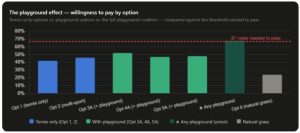
In brief: we received 104 responses representing 46% of our households across all nine options, covering willingness to pay, preference rankings, and written comments. The graphic below summarizes the key results at a glance:
Seven insights stand out as particularly important for charting a path forward:
- The community’s support for playground options is the clearest signal in the data.
One finding stands above all others in its consistency and strength: every option that includes a children’s playground outperformed its no-playground counterpart on every metric we measured — willingness to pay, preference rankings, and projected assessment support.
When we look at households willing to fund any playground option — whether paired with two courts, one court, or no courts — 68% of survey respondents said they would contribute. Applied to the 145 households who voted in the prior assessment, that projects to approximately 99 YES votes — above the two-thirds threshold required to pass. No other grouping of options reaches that level. The message from the community is clear: a children’s playground is not a peripheral add-on. It is the feature that brings enough of our community together to provide essential funding for a project.
- The playground effect is strongest when paired with tennis courts.
Among all nine options, the playground advantage is most powerful in the two-court configuration. Option 3A — restoring both tennis courts while converting the 30-foot side area into a multi-purpose community space with a playground — received 52% willingness to pay, compared to just 36% for the identical option without a playground. That 17-percentage-point gap is the largest playground advantage of any configuration.
For context: the prior special assessment received YES votes from approximately 45% of ballots cast. Option 3A projects approximately 75 YES votes at the same turnout — 10 more than the prior measure received — making it the strongest single option for an assessment vote. We are still approximately 22 votes short of passage, but the gap is meaningfully smaller than before.
- Options 1 and 2 — restoring the courts as they were, with or without multi-sport flexibility — cannot pass a community-wide assessment vote.
The data makes this clear. Option 1 received willingness to pay from 42% of respondents — a figure that closely matches the 45% who actually voted YES in the prior special assessment that failed. Option 2 fared only modestly better at 46%. Neither projects enough YES votes to clear the two-thirds threshold: Option 1 projects 61 YES votes, 36 short of the 97 needed; Option 2 projects 67, still 30 short.
This matters because the Board’s obligation is not simply to identify what some residents prefer — it is to find an option that can actually pass. Bringing Option 1 or Option 2 to a community-wide special assessment vote would almost certainly produce the same outcome as the assessment that already failed, at significant cost to the community in time, money, and goodwill. The Board does not believe it would be responsible stewardship to ask the community to vote again on an option the data shows cannot win.
We recognize this is a genuine disappointment for residents who value the tennis courts above all else and do not want to see the site change. The Board respects that position, and it is reflected in our focus on Option 3A — which restores both courts while adding the community amenities that broaden the YES coalition enough to make passage possible. For residents who want the courts back, Option 3A is the path most likely to actually get that done.
- Options without a playground would likely perform worse than the assessment that already failed.
Options 3B, 4B, and 5B — the no-playground variants of our community-space options — all project fewer YES votes than the prior assessment received. The data does not support putting any no-playground option to a community-wide vote.
- Option 6 (natural grass) does not reflect genuine community enthusiasm.
Option 6 received 14 first-choice votes, which may appear to suggest significant support. However, when households were asked to rank all nine options in order of preference, Option 6 finished last in our consensus analysis: it loses every single head-to-head matchup against every other option when you account for full household preferences. The households who ranked it first were largely the same households who said they would pay nothing toward it — indicating that these votes reflect a preference to avoid spending rather than genuine enthusiasm for a natural grass field.
Put simply: more households in our community prefer to pay a special assessment to create meaningful amenities than prefer to revert the space to natural grass. The survey makes this clear across multiple analytical methods.
- There is meaningful support for different court configurations — as long as a playground is included.
Beyond Option 3A, two other playground options generated strong interest. Option 4A (one tennis court plus a large L-shaped community space with playground) and Option 5A (no courts, full-site community space with playground) each received willingness to pay from 47% (4A) and 48% (5A) of respondents. Option 5A earned the most first-choice votes of any option (17) and the most top-3 placements (43 households). These options reflect different visions for the space, and the Board takes seriously that a significant portion of our community prefers reducing or eliminating the tennis courts in favor of broader community amenities.
- More than one-third of households expressed interest in voluntary contributions.
38% of respondents said they would be open to making a voluntary contribution to supplement a special assessment — a meaningful signal of community investment that the Board will explore further.
A NOTE ON THE 21 ADJACENT HOMES
Before the community-wide assessment can take place, our governing documents require a separate two-thirds vote of the 21 homes immediately adjacent to the Laurel Hill site — at least 14 of those 21 households must approve the chosen option. This vote failed in May 2025 with no option reaching the threshold.
Of the 21 adjacent households, 9 completed the survey. Their responses carry an important signal for Option 3A: 6 of those 9 said they would be willing to contribute financially to it — including residents whose first preference is a full tennis restoration. If that rate of support held across all 21 adjacent homes, it would project to exactly 14 approvals — right at the threshold, with no margin for error. That is a projection, not a guarantee, and 12 adjacent households did not respond to the survey at all. Their preferences are entirely unknown, and they represent the Board’s most urgent priority for direct engagement.
Note: We also want to acknowledge that on July 13, the Board received a petition via email, signed by 12 of the 21 adjacent homeowners expressing opposition to playground equipment and support for a tennis-only restoration. We respect the right of any resident to organize and make their views known. The Board reviewed the petition with legal counsel and confirmed that it does not carry any binding legal effect — any signatory remains free to change their position at any time prior to an official Board-initiated vote, and the petition does not alter the Board’s process or timeline in any way.
That said, we do not dismiss it. A petition signed by 12 of the 21 adjacent homes is a serious signal, and we want to be honest with the community about what it means: if those positions hold, we cannot reach the 14 approvals required to proceed.
We continue to believe the only way forward is patient, good-faith engagement — listening carefully to specific concerns, proposing concrete mitigations, and finding whether there is a version of one of the leading options that enough adjacent neighbors can accept. The Board is committed to that effort over the coming two weeks, and we remain genuinely hopeful that compromise is possible. What we know from the survey is that 6 of the 9 adjacent homeowners who responded said they would be willing to contribute financially to Option 3A — including some whose first preference is a tennis-only restoration and one household that signed the petition! That tells us the picture among the 21 homes is not uniform, views are constantly changing, and that there is real ground for conversation.
Beginning this week, Board members will visit or speak with each of the 21 adjacent homes personally — sharing the full community survey results, listening carefully to any concerns about noise, activity, or the character of the space, and working collaboratively to understand whether there are mitigations that could make one of the leading options work for them. We will be respectful of their proximity to the site and the legitimate interests they have as the homes most directly affected by whatever is built there.
WHAT THIS MEANS FOR THE BOARD’S STRATEGY
The Board’s task is to find a path to two hurdles: two-thirds of the community approving a special assessment, and two-thirds of the 21 adjacent homes approving the chosen option. The survey has given us strong guidance on the first hurdle. We now turn our attention to the second.
The survey data shows that playground inclusion is the non-negotiable thread running through all viable paths forward. Our door-to-door conversations with the 21 adjacent homes — which begin immediately and will continue through late July — will focus on Options 3A, 4A, and 5A, all of which include a playground, while remaining open to the court configuration that the adjacent homeowners can most readily accept.
The survey points most strongly toward Options 3A and 4A as the leading candidates for the assessment vote. The final determination will depend on what we hear from the adjacent homeowners.
On assessment sizing: among households willing to fund a playground option, the average willingness to pay was approximately $400 per household. The Board is considering a special assessment in the $275–$325 range — calibrated to maximize YES votes while generating meaningful project funding alongside our existing reserves and the VDOT settlement.
FULL SURVEY DATA AVAILABLE
In the interest of full transparency, the Board is making the complete survey analysis available to any resident who wishes to review it. The attached file contains every response we received, with names and addresses removed to protect respondent privacy, along with the full analytical workbook showing exactly how each figure was calculated. Every number in this email can be verified directly against the raw data — all values are formula-driven, not hard-coded. You can also access a plain-language summary of the results for each option in our supplemental appendix.
This file is comprised of three sheets as follows:
- Survey Results: Summary results
- Detailed Analysis: Detailed analyses of the data and key insights generated
- Option Illustrations: Shows the illustrative diagrams of each each option
- Form Responses 1: Raw survey data
TWO PATHS FORWARD
We want to be transparent about what the coming weeks will determine.
If the adjacent homeowners approve one of the leading playground options (3A, 4A, or 5A), the Board will proceed to a community-wide special assessment vote as soon as possible. If the assessment takes place quickly and passes, construction could begin as early as September — finally putting this long-stalled project to rest before winter. However its important to note that timing is absolutely critical: the construction company may not be able to schedule our project in September unless they receive a signed contract to proceed within the next few weeks. So our window to proceed with construction is narrow and shrinking with every day of delay.
If the adjacent homeowners are unwilling to approve any playground option despite our best efforts at compromise, construction this year becomes very unlikely. Our current contractor quote will expire, and we will almost certainly face higher costs when we revisit this in the spring. The Board will continue engaging with those households over the winter and bring the matter back to the full community in early 2027 with updated pricing.
We do not want to reach that second outcome. The community has spoken clearly — 68% of respondents are willing to fund a playground option, and the votes are there if we can concentrate them behind a single choice. The Board is committed to doing everything within its power, and within our governing documents, to reach a resolution this year.
JOIN US THIS EVENING
The Board will formally discuss the survey results and determine next steps at our upcoming Board meeting:
All residents are welcome to attend. Please note that resident speaking time will be limited at this meeting, as the primary purpose is for the Board to deliberate and make decisions based on the survey findings. However, depending on the level of community interest, the Board may schedule a dedicated town hall in the coming weeks to allow for more open discussion. We will communicate any such plans as soon as they are confirmed.
NEXT STEPS AND TIMELINE
- Board meeting to discuss survey results: Tuesday, July 14, 2026 at 7:30 p.m.
- Door-to-door engagement with the 21 adjacent homes: Now through late July
- Town hall (possible): To be determined based on community interest
- Special assessment vote (if adjacent homes approve): August 2026
- Construction begins (if assessment passes and construction company can schedule our project): Early September 2026
- If no resolution with adjacent homes: Board continues engagement over winter; revisit spring 2027 at likely higher cost
We will keep the community informed as our conversations with the adjacent homeowners progress. If you have questions or would like to speak with a Board member, please reach out.
Thank you again for your participation. This is a decision that will shape our neighborhood for decades, and your voice has shaped this analysis. We are determined to deliver a result this neighborhood can be proud of.
Warm regards,
Ridah Sabouni
President, WTWHA Board of Directors